Unraveling cosmic mysteries beyond our known celestial frontier
The universe rarely breaks its silence. Yet, every once in a cosmic age, something enters our Solar System that challenges every assumption we have ever held about space, creation, and our place in the cosmos.
It starts as a dim glimmer in the blackness a faint, almost ignorable spark. But astronomers noticed. Telescopes re-aligned. Antennas tracked its path. Artificial intelligence monitoring systems flagged its motion. And suddenly, the scientific world found itself staring at an interstellar traveler that should not exist, at least not in this form.

This is not science fiction. This is the mystery of 3I/ATLAS, the latest interstellar object to cross into our cosmic neighborhood. Before anyone could fully grasp its nature, debates erupted among astronomers, physicists, and astrobiologists. Was this another icy relic like 2I/Borisov? Or was it more like ʻOumuamua, the first ever interstellar visitor that baffled scientists and ignited theories of alien technology? Or was this something entirely new—something that defies our models of planetary formation and cosmic chemistry?
Today, the world watches closely. Because, unlike shooting stars that burn quick and disappear, 3I/ATLAS has arrived as if on a purposeful trajectory, moving along a plane curiously aligned with our Solar System, shedding clues but never enough, whispering secrets through the gases it expels, leaving us to question: Who or what sent this visitor?
Welcome to the first part of our deep-dive series into the cosmic enigma known as 3I/ATLAS. As the mystery deepens, you, the reader, may be witnessing one of the most profound astronomical moments of our century.
A Cosmic Arrival Unlike Any Other
 |
| A recent Gemini Observatory image of comet 3I/ATLAS (background) overlaid with the new Two-meter Twin Telescope image of the comet's jet (inset). (Image credit: Comet photograph: International Gemini Observatory/NOIRLab/NSF/AURA/Shadow the ScientistImage Processing: J. Miller & M. Rodriguez (International Gemini Observatory/NSF NOIRLab), T.A. Rector (University of Alaska Anchorage/NSF NOIRLab), M. Zamani (NSF NOIRLab); Inset: Teide Observatory, M. Serra-Ricart, Light Bridges) |
3I/ATLAS, officially recorded in 2025, is only the third confirmed interstellar object ever detected entering our Solar System. That alone is astonishing. Most cosmic bodies orbit around the Sun, bound by gravity like planets, asteroids, and classical comets. But this object is not from here. Its hyperbolic path, its velocity, and its chemical fingerprint all tell a story that began light-years away, in a star system alien to us.
Astronomers first identified it using the ATLAS survey system, a planetary defense network designed to detect incoming threats. Yet this object was not a threat it was a revelation. The moment data confirmed that its trajectory was not gravitationally bound to the Sun, the narrative changed. Humanity was once again staring at a messenger from beyond.
Telescopes across the globe, including the James Webb Space Telescope, locked onto it. In those first few days, scientists expected a frozen ball of dust and ice, similar to comets born in the Oort Cloud. Instead, they found a composition so unusual it challenged comet chemistry as we know it. The comet showed exceptionally high carbon dioxide output and surprisingly weak water signals a chemical fingerprint that suggests it formed in a region colder and more distant than typical planetary nurseries. This is material from the outskirts of another star’s disk an ingredient list from a cosmic kitchen we have never tasted before.
Every emission, every spectral reading, every fragment of dust it sheds carries the signature of another world. Studying 3I/ATLAS is not just astronomy it is the closest thing to interstellar archaeology humanity has achieved so far.
The Suspicious Trajectory: Nature or Intelligence?
 |
| Objeto interestelar denominado como 3I/ATLAS | GTLZA NASA |
Coincidence? Perhaps. But coincidences of this scale spark healthy scientific skepticism.
Some astrophysicists argue it could be coincidence, a natural trajectory shaped by gravitational interactions over billions of years. Others, including voices like Harvard astrophysicist Avi Loeb (who famously suggested ʻOumuamua might be artificial), noted the alignment as “statistically curious.” When objects enter our system in ways mathematically unlikely, the question naturally arises: could this be technology, not geology?
Mainstream science maintains caution but not dismissal. After all, humanity has only been studying interstellar visitors for a handful of years. The very fact that 3I/ATLAS is here forces us to reconsider how many such objects may pass unseen, how many secrets drift through the galaxy, and whether intelligent life might use natural-looking debris as probes or messengers.
For now, 3I/ATLAS appears physically comet-like, expelling gases in solar heat—but the chemical ratios, dust geometry, and trajectory alignment remain unlike any comet seen before.
The mystery grows deeper, not thinner.
A Geological Time Capsule from Beyond Our Sun
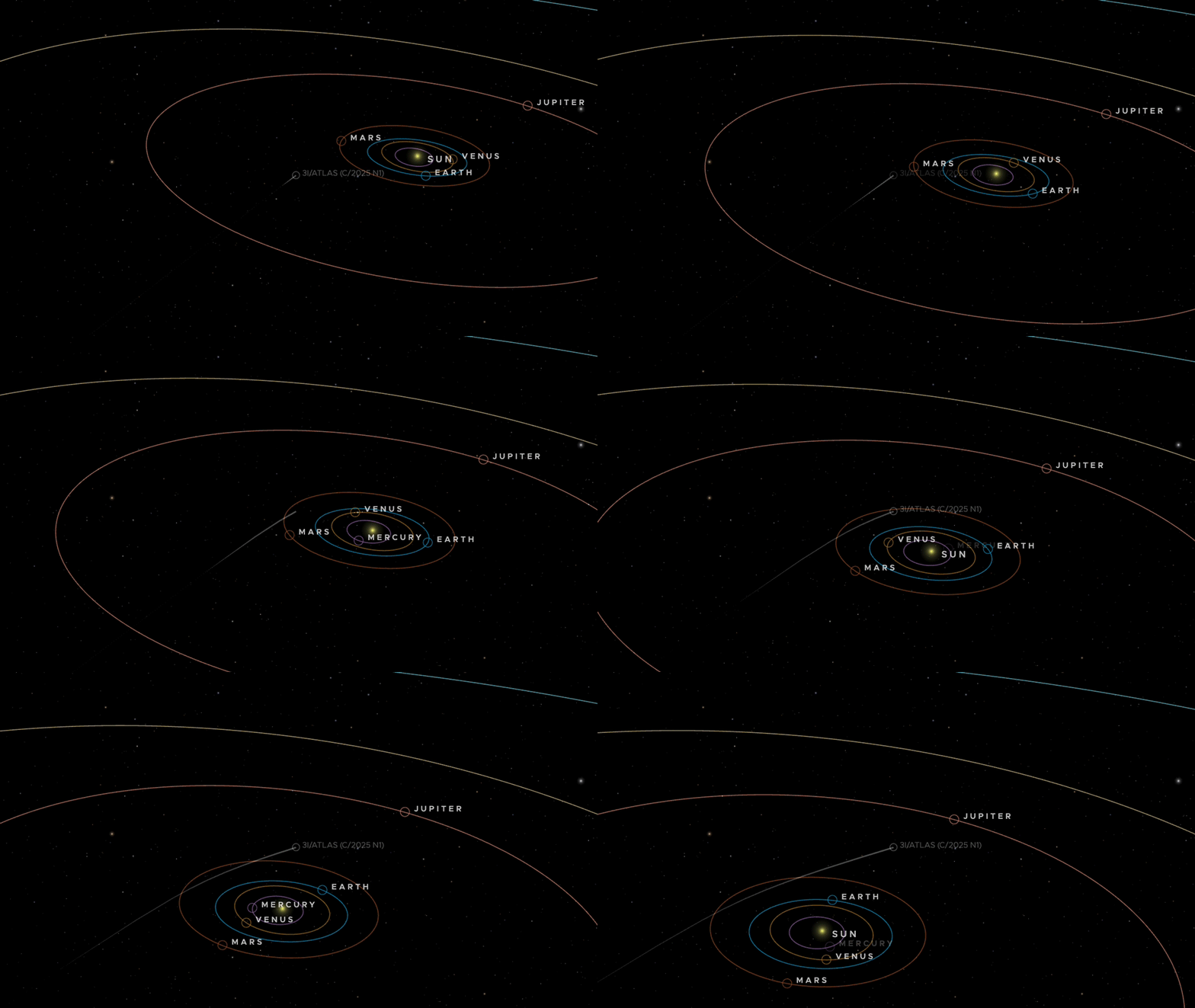 |
| 3I/ATLAS Trajectory |
When you look at images of 3I/ATLAS, you are witnessing ancient chemistry a frozen memory of a star system that may not even exist anymore.
Its dust, analyzed by spectroscopy, reveals grains unlike those commonly seen in Solar System comets. Its volatile gases speak of extreme cold environments. Establishing its origin could provide direct evidence about conditions beyond our stellar neighborhood. It is not simply “from another star” it may be a direct sample from another world’s birth cradle.
Imagine studying a fragment of a foreign planet without ever leaving our own. That is the gift this object brings a cosmic teaching tool offering knowledge across unimaginable light-years.
Why Scientists Are Racing Against Time
 |
| There are new updates on 3I/ATLAS! After the Hubble Space Telescope took a closer look at the interstellar visitor, it is now clear that a real-life Speedy Gonzales has entered the solar system! The bottom line is that this mysterious celestial body is nothing less than the fastest object ever observed in our home world! At the same time, Hubble also provided important new data on the size and activity of the chunk – but its exact origin remains a mystery. And so, speculation about the true background of 3I/ATLAS continues unabated. According to Avi Loeb, it is even possible that the interstellar object has its own light source: simply because we may be dealing with an extraterrestrial spacecraft powered by nuclear energy! But what does the rest of the research community say about this provocative thesis – and what reliable facts are now available about 3I/ATLAS? |
The window to observe 3I/ATLAS is brutally short. It approaches the Sun, brightens briefly, then fades into vast distance, never to return. Humanity will not get a second chance. Unlike ʻOumuamua, whose surprising behavior was discovered too late for deep observation, this time astronomers are prepared. Instruments like JWST, Hubble, ALMA, and ground-based spectrometers worldwide are capturing everything they can before 3I/ATLAS vanishes forever into interstellar night.
Yet even with the greatest scientific technology in history, many properties remain unresolved. The core size remains uncertain, obstructed by dust coma and dynamic outgassing. Estimates swing widely, hinting it may be far larger than typical comets possibly tens of kilometers in diameter if some models are correct.
Every dataset complicates the story. Every measurement reveals new anomalies. And the more we learn, the more familiar yet foreign it feels, like a puzzle piece from a picture we have never seen.
The Interstellar Visitors Before It: Lessons from ʻOumuamua and Borisov
To understand the gravity of 3I/ATLAS, we look to its predecessors. ʻOumuamua passed silently, without a cometary tail, accelerating as if pushed by unknown propulsion. Some said it was natural; others suggested alien technology. Debate continues to this day. Then came Borisov a clearly cometary visitor, behaving exactly as expected, providing comfort in predictability.
3I/ATLAS is neither. It bridges the unknown and the familiar. It resembles a comet, yet refuses to behave like one chemically or dynamically. It carries water, yet hides it. It releases CO₂ like a factory of frozen gas. It obeys comet physics, yet hints at engineering of cosmic coincidence in trajectory.
This third encounter deepens the mystery of interstellar phenomena. If ʻOumuamua was the question, and Borisov was the baseline, ATLAS may be the chapter that forces the textbook rewrite.
A Window Into Alien Chemistry and World-Building
The discovery of 3I/ATLAS could redefine planetary science. If systems elsewhere form comets rich in CO₂ but deficient in water, then our own watery world may not be the norm. The building blocks of life carbon, water, organics might distribute differently across the galaxy. Life-friendly planets may be rare, or abundant in unimaginable forms. Understanding these ratios shapes our understanding of habitability, exoplanet diversity, and cosmic life probability.
Whether or not life exists elsewhere, 3I/ATLAS is a biological clue a chemical breadcrumb from a stellar system we may never directly observe.
Suspense Without Resolution—Yet
As we document 3I/ATLAS’ fleeting passage, humanity stands again at the threshold of curiosity and wonder. The ancient visitor glides silently through the black. It tells no stories aloud, but leaves trails of cosmic secrets in its wake.Is it a frozen archive of another star’s past?
A natural messenger of deep time?
A silent probe surveying civilizations too young to detect their watchers?
Or something else entirely something we have no language for yet?
We will follow this mystery further. We will study its gases, model its origin, and challenge our cosmic assumptions. The second part of this investigation will explore mission concepts, astrobiology implications, and deeper theoretical models including those few brave scientific voices asking whether intelligence can ever appear disguised as physics.
For now, one question lingers like starlight that refuses to fade:
If this visitor is only natural, why does it feel so intentionally placed? And if it is not… who placed it?


.png=w352-h279-p-k-no-nu)


0 Comments